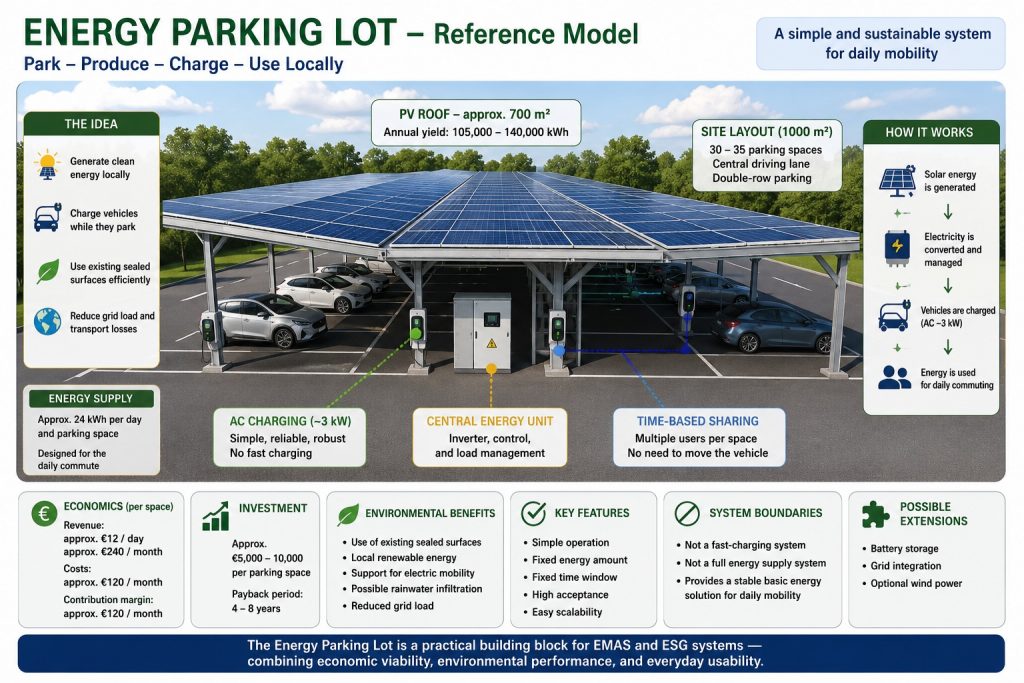
ENERGY PARKING LOT – Reference Model (EMAS-based)
1. Purpose
The energy parking lot is a simple, economically viable and sustainable parking system that:
- generates electricity via photovoltaics
- supports daily employee mobility
- reduces environmental impacts of parking infrastructure
It provides reliable basic energy supply for daily commuting while linking mobility and local energy production.
2. Scope
Applicable for:
- companies of all sizes
- new developments and existing sites
- areas from approx. 500 m²
Reference model: 1000 m² standard site
3. Definitions
- Energy parking lot: integrated system combining parking space, energy generation and charging infrastructure
- Basic supply: defined daily energy amount per vehicle use
- Parking cluster: multiple users per parking space in a time-based model
4. Responsibilities
- Employer: infrastructure provision
- Users: operation according to site rules
- System: largely automated and standardized
5. System description
5.1 Site layout (1000 m²)
- 30–35 parking spaces
- central driving lane
- double-row parking layout
5.2 Structure
- modular steel or stainless-steel construction
- bolted design (reversible and recyclable)
5.3 Photovoltaics
- approx. 700 m² PV area
- annual yield: 105,000–140,000 kWh
- high on-site consumption in summer
6. Charging and usage concept
6.1 Technology
- AC charging (~3 kW)
- no fast charging by design
- robust standard technology
6.2 Operating time
- 08:00 – 16:00
6.3 Energy supply
- approx. 24 kWh per day per parking space
→ designed for daily commuting needs
6.4 Usage model
- multiple users per space (time-based system)
- no need to relocate vehicles
- simple access logic
7. Economic feasibility
Revenue
- approx. 12 € per day
- approx. 240 € per month
Costs
- approx. 120 € per month electricity
→ contribution margin: approx. 120 € per month
8. Investment
- approx. 5,000–10,000 € per parking space
- payback period: 4–8 years
9. Environmental aspects
- use of already sealed surfaces
- local energy generation
- support for electric mobility
- possible rainwater infiltration
- reduced grid load
10. Environmental assessment framework
Considered factors:
- climate
- water
- soil
- energy
- light / reflection
- temperature
- wind
Goal: early identification and minimization of environmental impacts
11. Operating principle
The system is intentionally simple:
- fixed energy amount
- fixed time windows
- no complex optimization logic
Result:
- high acceptance
- low complexity
- easy scalability
12. Technical and organizational notes
- grid connection and load management required
- suitable charging infrastructure needed (CEE / wallbox)
- weather-resistant design required
- regulatory approval varies by region
- reduced PV yield in winter
- soiling (dust/birds) must be considered
- storage optional, not required
13. System boundaries
The energy parking lot is:
- not a fast-charging system
- not a full energy supply system
but a stable basic mobility energy solution
14. Extensions
- battery storage
- grid integration
- optional wind power
15. Evaluation
The system combines:
- economic viability
- environmental performance
- everyday usability
It is a practical building block for EMAS and ESG systems.
16. Conclusion
The energy parking lot provides a simple, predictable and sustainable solution for everyday mobility energy needs.
It does not replace everything – but it delivers what matters: reliable energy for daily commuting.