
1 🧠 Brainstorming 🎄🌍✨
AKO-1, biotechnology, ethanol, starch, sugar, 73°C, bacteria, AKO-1, East Africa, waste heat, heat, cooling, water, seawater, saline, Jerusalem artichoke, glasswort, waste, pipeline, transport, dual use, jobs, heat protection, infrastructure, biofuel, e-fuel, potassium, fertilizer, greening, OASIS, electricity, energy, heat pump, solar thermal, PV fields, solar mirror power plants, geothermal (shallow/deep), waste heat utilization, thermal storage (short- & long-term), Carnot process, sorption cooling, seawater desalination, condensation cooling, evaporative cooling, dehumidifiers, CO₂ scrubbers, dolomite / magnesium carbonate, lime cycle (CaO ↔ CaCO₃), circular energy, low-energy farming, industrial heat 60–140°C, process optimization, algae cultures (CO₂ sink + biomass), cyanobacteria, fungal cultures, fermentation, biopolymers, organic acids, protein production, composting, humus formation, saltwater plants (halophytes), mangroves, reforestation, microalgae for fuels, mussel farming, coral farming (carbonate cycle), fog condensation, cold air generation, shading, albedo increase, evaporation reduction, water treatment, aquifer storage, drinking water production, greywater, freshwater islands, green corridors, local value creation, resilience, education systems, qualification, security of supply, infrastructure development, climate-resilient cities, new trades, regional scalability, export of know-how, fair supply chains, renewable industrial clusters, DUGV principles (Your Environment – Hazard – Responsibility), container solutions, modular systems, plug-and-play, port connection, desert logistics, circular vessels, micro-plants, skid-mounted systems, hubs & satellite locations, water towers, pipeline mini-grid, albedo, ice retreat, air volume flow, temperature gradient, water vapor, cloud base, near-surface zone below the cloud layer, biomass decline, soil sealing, heat islands, reflection loss, solar load, dark surfaces, IINKA core idea, global scalability, integration, innovation, natural cycle, climate adaptation, exchange, autonomy, IINKA modules, OASIS systems, planetary responsibility, regional optimization
2 🗂️ Cluster 🦠🌱💧⚡🏗️🌍🧩
| Cluster | Icon | Keywords | Not directly relevant / Note |
|---|---|---|---|
| Biotechnology & Bio-Production | 🌱 🦠 | AKO-1, biofuel, e-fuel, ethanol, starch, sugar, yeasts, fungi, protein production, organic acids, biopolymers, microalgae for fuels, algae cultures (CO₂ sink + biomass), mussel farming, coral farming | – retrieve only if needed |
| Agriculture & Plants | 🌿 | Albedo, humus formation, composting, reforestation, greening, shading, dual use, Jerusalem artichoke, glasswort, saltwater plants, potassium, low-energy farming, local value creation, OASIS, resilience, evaporation reduction, green corridors | – |
| Energy & Processes | ⚡ | 73°C, waste heat, waste heat utilization, geothermal (shallow/deep), industrial heat 60–140°C, PV fields, solar mirror power plants, solar thermal, sorption cooling, thermal storage, heat pump, heat | Carnot process, dolomite / magnesium carbonate, circular energy, lime cycle – currently not relevant |
| Water & Cooling | 💧 | CO₂ scrubbers, condensation cooling, greywater, cold air generation, dehumidifiers, seawater, seawater desalination, fog condensation, freshwater islands, drinking water production, evaporative cooling, water treatment | Aquifer storage – currently not relevant |
| Infrastructure & Logistics | 🏗️ | Albedo, jobs, container solutions, dual use, port connection, heat protection, infrastructure, infrastructure development, modular systems, new trades, regional scalability, transport, water towers, desert logistics | Export of know-how, circular vessels, micro-plants, plug-and-play, security of supply, skid-mounted systems, hubs – currently not relevant |
| Climate Factors & Environment | 🌍 | Albedo, air volume flow, temperature gradient, water vapor, cloud base, soil sealing, heat islands, solar load, dark surfaces, reflection loss | Ice retreat, biomass decline – currently not relevant |
| Management & Strategy | 🧩 | global scalability, IINKA core idea, IINKA modules, innovation, climate adaptation, natural cycle, OASIS systems, planetary responsibility, regional optimization, integration | Autonomy – currently not relevant |
3 🦠 AKO-1
The strain AKo-1 (type strain AKo-1 = ATCC 43586 = DSM 3389) is now classified as Thermoanaerobacter brockii subsp. finnii (synonym / older name: Thermoanaerobacter finnii).
🔎 3. When Heat Becomes Alive
Sometimes nature reminds us how little we actually know.
Our microbe 🦠—a thermophilic organism discovered in East Africa’s Lake Kivu—thrives where we would already need protective equipment: between roughly 40 and 75 °C, completely without oxygen. And yet, it effortlessly produces ethanol and CO₂.
Why does this matter?
Because it shows that biological processes can operate at much higher temperatures than we typically assume in environmental engineering. Thermophilic microbes like 🦠 open up a field we have barely explored:
- Biotechnology using waste heat
- Fermentation near process heat
- Energy production in extreme environments
The question is not whether it works—the microbe 🦠 has long been demonstrating it.
The question is whether we are ready to rethink our approach before energy crises or climate change force us to.
Extremophiles remind us:
Nature is ahead of our systems.
Perhaps that is exactly the spark we need—in the middle of Advent.
| Element | Representation / Notes |
|---|---|
| Main keyword | 🌱 AKO-1 |
| Short description | Thermophilic microorganism that efficiently converts starch-rich biomass into sugar and bioethanol. Suitable for various climate regions. |
| Technology & Processes | – Substrate preparation: shred starch-containing raw materials (corn, Jerusalem artichoke) and pre-treat enzymatically – Fermentation: sugar → bioethanol via thermophilic microbes; contamination reduced |
| Regional specifics | Cold / temperate regions: advantage: stable temperatures, high efficiency; disadvantage: heating required → energy demand; solution: waste heat, thermal storage, solar thermal. Hot regions (Sahel): advantage: daytime heat supports fermentation; disadvantage: risk of overheating → cooling required; solution: store heat at night → continuous fermentation |
| Product recovery | Distillation and processing of ethanol; surplus biomass usable as fertilizer, animal feed, or raw material |
| Role in the overall system | – Local bioethanol production reduces transport costs & CO₂ – Combination with PV, solar thermal, and thermal storage increases efficiency – Supports regional OASIS concepts: interconnected energy, water, and agriculture |
| Explanatory keywords / context | Bioethanol, starch/sugar, thermophilic microbes, fermentation, temperature management, Jerusalem artichoke, local value creation, energy integration, humus formation |
4 💛 Bioethanol
| Element | Representation / Notes |
|---|---|
| Main keyword | 💛 Bioethanol |
| Short description | Bioethanol is a renewable fuel derived from biomass such as corn, grain, or Jerusalem artichoke. It serves as an energy source for industry, transport, and local energy systems. |
| Technology & Processes | – Substrate preparation: shredding, enzymatic treatment – Fermentation by thermophilic microbes (e.g., AKO-1) – Distillation for ethanol recovery – Surplus biomass usable as fertilizer or animal feed |
| Regional specifics | Cold regions: energy may need to be supplied for fermentation → thermal storage recommended. Hot regions: fermentation of naturally warm biomass possible; cooling required in case of overheating; heat can be stored at night. |
| Role in the overall system | – Local fuel production reduces transport CO₂ – Combination with PV systems or solar thermal increases efficiency – Supports OASIS concepts: interconnected energy, water, and agriculture |
| Explanatory keywords / context | AKO-1, starch/sugar, fermentation, waste heat utilization, Jerusalem artichoke, local value creation, energy integration |
5 💧 Drinking Water Production
| Element | Representation / Notes |
|---|---|
| Main keyword | 💧 Drinking water production |
| Short description | Production of drinking water from seawater, greywater, or freshwater sources—essential for agriculture, industry, and communities, especially in dry regions. |
| Technology & Processes | – Seawater desalination (reverse osmosis, evaporation) – Use of dehumidifiers and condensation – Storage in freshwater islands or aquifers – Treatment for human consumption or agriculture |
| Regional specifics | Cold regions: energy demand for desalination can be supported by solar thermal/PV. Hot regions: higher evaporation → efficiency loss; fog condensation possible; thermal management important. |
| Role in the overall system | – Foundation for local OASIS systems – Connection to bioethanol plants: water demand for fermentation and cooling – Resilience against drought periods |
| Explanatory keywords / context | Seawater desalination, evaporative cooling, dehumidifiers, freshwater islands, waste heat utilization, local value creation |
6 ⚡ PV Fields + Solar Thermal
Photovoltaic fields and solar thermal systems provide the energy our thermophilic microbes need for ethanol production. Yet large solar areas also change their surroundings: they reduce albedo—the reflectivity of the Earth’s surface—and can therefore contribute to local warming. This is precisely why every solar field needs an intelligent environmental concept: the OASIS.
The OASIS connects energy generation with climate protection. It ensures that dark PV surfaces do not stand isolated in the landscape but are embedded within reflective and cooling elements. Particularly effective are aluminum mirrors which—unlike silver mirrors—also efficiently reflect UV components. This creates an active brightness and cooling effect that partially restores lost albedo.
When PV, solar thermal, and reflective aluminum surfaces are combined, the result is a self-sufficient micro-energy system: electricity for microbial reactors, heat for process steps—and at the same time a brighter, more climate-friendly environment. The OASIS makes solar parks not only productive but ecologically stable.
It becomes clear: if we use the energy of the sun, we should think about the light as well. Sustainable energy begins not only on the panel—but throughout the entire system.
| Element | Representation / Notes |
|---|---|
| Main keyword | ⚡ PV Fields + Solar Thermal |
| Short description | Combination of photovoltaics and solar thermal for simultaneous electricity and heat generation. Enables energy supply for industrial processes, fermentation, and drinking water production. |
| Technology & Processes | – PV fields generate electricity for pumps, cooling, process control – Solar thermal provides heat for substrate preparation, thermal storage, fermentation – Short- and long-term storage for day/night supply |
| Regional specifics | Cold regions: solar thermal supplements fermenter heating; thermal storage increases efficiency. Hot regions: daytime heat can optimize PV and solar thermal; fermenter cooling required; store heat at night. |
| Role in the overall system | – Enables continuous fermentation in AKO-1 facilities – Increases efficiency of bioethanol production, drinking water generation, and OASIS systems – Reduces dependence on fossil fuels |
| Explanatory keywords / context | PV fields, solar thermal, thermal storage, waste heat utilization, continuous fermentation, energy integration, OASIS |
7 🌿 OASIS
🌿 OASIS: The Climate Concept That Transforms Solar Parks
The OASIS is more than an idea—it is a system. An approach that demonstrates how technical energy generation and natural cooling can merge. Wherever large PV fields, solar thermal areas, and dark surfaces emerge, albedo decreases and the surrounding area warms. The OASIS addresses exactly this point.
It combines reflection, shading, greening, solar technology, and water management into a holistic picture. Aluminum mirrors increase brightness and—unlike traditional silver mirrors—efficiently reflect UV components back into the sky. Green zones and vegetation corridors create microclimates that dissipate heat, retain moisture, and promote biodiversity. At the same time, PV and solar thermal provide electricity and process heat for our thermophilic microbes—the foundation for climate-positive ethanol production.
Thus, a conventional solar park becomes a cooling, reflective, productive ecosystem—a technical landscape that not only generates energy but actively contributes to stabilizing local temperatures.
More at dugv.org/oase
The OASIS shows: climate protection succeeds where we think technology and nature together. 🌿
| Element | Representation / Notes |
|---|---|
| Main keyword | 🌿 OASIS |
| Short description | Systemic concept integrating water, energy, and agriculture. Goal: regional resilience, local value creation, and sustainable energy supply. |
| Technology & Processes | – Combination of green areas, PV/solar thermal, and water management – Use of waste heat, thermal storage, and evaporation reduction – Modular structure for regional scalability |
| Regional specifics | Cold regions: cooling rarely needed; heating demand covered by solar thermal. Hot regions: temperature control, use thermal storage for night operation, evaporation reduction. |
| Role in the overall system | – Links bioethanol production, drinking water generation, and energy production – Supports OASIS concepts as a model for sustainable cities and industrial clusters |
| Explanatory keywords / context | Greening, water treatment, dual use, resilience, waste heat utilization, local value creation, energy integration |
8 🌱 Jerusalem Artichoke
🌱 Jerusalem Artichoke: The Resilient Plant for a Resilient Future
Jerusalem artichoke is more than a crop—it is a strategic building block of sustainable energy production. With its starch-rich tubers, it provides an ideal raw material for our thermophilic microbes, which convert it into valuable ethanol. Yet its strength lies not only in yield but in its characteristics: Jerusalem artichoke grows on poor soils, tolerates drought, and regenerates itself year after year. A plant that does not take—but gives.
In times of scarce resources and increasing soil erosion, Jerusalem artichoke becomes a symbol of agriculture that adapts rather than exploits. Its deep roots improve soil structure, increase water retention capacity, and promote humus formation—a quiet climate protection program beneath the ground. At the same time, its high biomass growth enables efficient energy use, especially when combined with OASIS, PV, and solar thermal.
When we view Jerusalem artichoke as part of an integrated system—water, light, microbes, plants—a cycle emerges that produces energy, strengthens soils, and remains ecologically stable.
Jerusalem artichoke shows: solutions often grow where we have long overlooked them. 🌱
| Element | Representation / Notes |
|---|---|
| Main keyword | 🌱 Jerusalem Artichoke |
| Short description | Versatile plant for bioethanol production, animal feed, or food. Highly resilient across different climate regions. |
| Technology & Processes | – Harvesting and shredding – Starch pre-treatment for fermentation (AKO-1) – Processing biomass into bioethanol or fertilizer |
| Regional specifics | Cold regions: consider growing season; frost protection necessary. Hot regions: high drought resistance; irrigation may be required; can complement OASIS systems. |
| Role in the overall system | – Local value creation and food security – Feedstock for bioethanol and OASIS systems – Supports resilience in hot and dry areas |
| Explanatory keywords / context | Bioethanol, AKO-1, local value creation, agriculture, CO₂ sink, energy integration |
9 🏜️ Jojoba & 🌳Empress Tree & 🌿Acacia
Sometimes plants show us how the future works. Jojoba, acacias, and the empress tree are three such guides — made for poor soils, extreme conditions, and high value creation.
Jojoba is considered one of the most resilient desert plants. With deep roots, it accesses water from layers unreachable to other vegetation. It protects soil from erosion, withstands heat, drought, and UV radiation — while simultaneously producing high-quality oil usable in technical, cosmetic, and energy applications. Jojoba demonstrates that resilience can emerge even in seemingly hostile regions — if we allow it.
The empress tree (Paulownia) forms the counterpart: extremely fast-growing, lightweight, yet strong. Its wood is sought after for furniture, construction, and musical instruments, while its enormous growth rate binds CO₂ and regenerates degraded soil. Paulownia thrives where conventional forestry fails — creating valuable biomass within just a few years.
Acacias are drought-resistant, possess deep root systems, and often have small or feathered leaves that reduce water loss — characteristics that make them particularly suitable for the Sahel region.
Together, these plants convey a clear message:
The future emerges where adaptability and value creation intersect.
They complement PV, solar thermal systems, and microbial processes by stabilizing landscapes, strengthening material cycles, and simultaneously providing usable raw materials.
Plants for extremes — and building blocks of a robust, climate-compatible energy future.
| Element | Representation / Notes |
|---|---|
| Main keyword | 🌿 Jojoba & Empress Tree & Acacia – Plants for Extremes |
| Short description | Three plants suited for extreme conditions: • Jojoba as a heat- and drought-tolerant desert plant • Empress tree (Paulownia) as a fast-growing, lightweight timber source. Both improve microclimate, albedo, soil stability, and support OASE and resilience systems. • Acacias are drought-resistant, have deep root systems, and often small or feathered leaves that reduce water loss — making them particularly suitable for the Sahel. |
| Technology & processes | – Jojoba, acacia: deep roots, minimal water demand, suitable for drip and OASE irrigation – Empress tree: rapid growth, strong CO₂ binding effect, provides durable lightweight timber – Can be combined with PV fields, shading systems, and cooling concepts – Used in reforestation, greening, erosion control, and raw material production |
| Regional characteristics | Hot regions (Sahel, deserts): • Jojoba and acacia are highly suitable due to extreme heat tolerance • Improvement of albedo (jojoba) and microclimate (both) Warm to temperate regions: • Empress tree ideal as a timber source and CO₂ sink • Suitable for greening and microclimate regulation Cool nights in hot regions: • Stabilize temperature profiles for PV, fermentation, and OASE systems |
| Role in the overall system | – Contribution to heat protection, increased albedo, and reduced evaporation – Raw material production (oil / timber) for local value creation – Supports regional resilience and climate stability – Component of sustainable OASE, greening, and energy network systems |
| Explanatory keywords / context | Jojoba, acacia, empress tree, albedo, microclimate, OASE, heat reduction, CO₂ sink, greening, resilience, water balance, lightweight timber |
10 ⚡ Waste Heat Utilization
Energy we already possess
Waste heat is one of the most underestimated energy sources of our time. While we plan new power plants and expand renewable technologies, enormous amounts of energy escape unused into the environment every day — from industry, data centers, fermenters, engines, chemical processes, and even from the reactors of our thermophilic microbes.
One principle applies: every kilowatt-hour that does not need to be newly generated is the most sustainable kilowatt-hour of all.
Our microbial ethanol production not only provides valuable energy but also generates usable process heat. This heat can be used for preheating water, drying biomass, heating buildings, or operating heat pumps. What was once a by-product becomes a strategic advantage.
The potential is equally clear in larger systems:
Waste heat from PV inverters, solar thermal plants, industrial facilities, or seawater desalination can be integrated into heating networks, greenhouses, aquaculture systems, or drying lines. This creates a cycle in which energy is used multiple times — before reaching the surrounding environment.
Waste heat utilization is no longer an add-on but a key to efficiency. It connects technical processes with climate-friendly practice and makes production chains more resilient.
The message is simple:
We already possess vast amounts of energy. We simply need to learn not to lose it.
| Element | Representation / Notes |
|---|---|
| Main keyword | ⚡ Waste Heat Utilization |
| Short description | Use of heat from fermentation, solar thermal systems, or PV processes to deploy energy efficiently and optimize operations. |
| Technology & processes | – Heat storage in short- or long-term systems – Heat for substrate preparation, fermentation, drinking water treatment – Integration into OASE systems and industrial processes |
| Regional characteristics | Cold regions: Fermenter heating possible, efficiency increase Hot regions: Excess heat can be stored at night; fermenters require cooling during the day |
| Role in the overall system | – Enables continuous fermentation – Increases energy efficiency and reduces CO₂ emissions – Supports regional OASE systems and sustainable production |
| Explanatory keywords / context | Heat storage, fermentation, PV/solar thermal, continuous operation, temperature management, energy integration |
11 💧 Cooling / Evaporative Cooling
The quiet power of natural cooling
When water evaporates, something remarkable happens: heat disappears from the surroundings without additional energy input. Evaporative cooling is one of the most elegant forms of natural cooling — and it plays a central role in stable climate systems and technical installations.
In our processes — from seawater treatment to fermentation and PV and solar thermal fields — heat islands repeatedly form. Yet especially in the hot regions where we aim to operate, cooling is not a luxury but a necessity. Here, even small amounts of water help: as mist, as a thin film, in shaded channels, or via capillary materials. Every drop that evaporates lowers the temperature in the immediate environment.
The OASE leverages this effect deliberately: bright surfaces reflect, vegetation provides shade, and water channels and evaporation zones create microclimatic cooling buffers. This increases PV efficiency, protects soils, and relieves reactors. Even a light airflow can multiply the effect.
Evaporative cooling is therefore more than physics — it is a tool for healthy landscapes, pleasant working environments, and energy-efficient production. It connects technical systems with natural intelligence.
The message:
Sometimes cooling does not arise from force — but from subtlety.
| Element | Representation / Notes |
|---|---|
| Main keyword | 💧 Cooling / Evaporative Cooling |
| Short description | Cooling is essential for fermentation, PV systems, and plant growth in hot regions. Evaporative cooling and dehumidifiers help secure optimal conditions. |
| Technology & processes | – Use of dehumidifiers, condensation cooling, and evaporation surfaces – Integration into OASE and fermentation systems – Night cooling and heat storage for continuous operation |
| Regional characteristics | Hot regions (Sahel): Daytime temperatures >40 °C → cooling required for fermentation; plants benefit from evaporation-reducing measures Cold regions / nights in hot zones: Storage of excess heat for nighttime operation |
| Role in the overall system | – Secures continuous bioethanol production and water supply – Protects plants (empress tree, jojoba) from heat stress – Supports OASE and PV systems |
| Explanatory keywords / context | Dehumidifiers, evaporative cooling, fermentation, OASE, temperature management, heat protection, nighttime heat storage |
12 ⚡ Heat Storage
Holding onto energy instead of letting it escape
Heat is valuable — yet it often slips away faster than we can use it. Heat storage changes this picture. It retains energy where it is generated and releases it when it is truly needed, closing a central gap in modern energy systems: time.
Whether in seawater treatment, microbial fermentation, or solar thermal plants — phases of excess heat arise everywhere. Without storage, they dissipate. With storage, new possibilities emerge: preheating water, stabilizing processes, relieving peak loads, and supplying energy at night or during cloud cover.
Heat storage can be simple — water tanks, sand, stone, saline solutions — or highly advanced, such as phase-change materials that absorb heat during melting or solidification. What matters is their position within the system: they connect PV, solar thermal, waste heat sources, and the needs of our thermophilic microbes into a continuous energy cycle.
Within the OASE, heat storage becomes a stabilizing element: smoothing temperature fluctuations, protecting processes from heat and cold, and ensuring energy is not lost but remains usable multiple times.
The message is simple:
Those who store heat store the future.
| Element | Representation / Notes |
|---|---|
| Main keyword | ⚡ Heat Storage |
| Short description | Storage of heat from fermentation, solar thermal, or PV systems for continuous operation, even in hot regions with day-night temperature fluctuations. |
| Technology & processes | – Short- and long-term storage – Use of heat for preheating substrate or plant irrigation – Optimization of OASE systems through day/night energy balancing |
| Regional characteristics | Hot regions: Store daytime heat → use at night for fermentation or cooling; plants benefit from stable temperatures Cold regions: Heat supply for fermenters, frost protection possible |
| Role in the overall system | – Ensures continuous production of bioethanol and drinking water – Increases efficiency of PV/solar thermal plants – Supports plant growth, resilience, and OASE systems |
| Explanatory keywords / context | Heat storage, nighttime operation, waste heat utilization, PV/solar thermal, OASE, empress tree, jojoba, temperature management |
13 ⚡ Saltworks & Seawater Evaporation
Using what the sun and wind provide
Saltworks are among humanity’s oldest solar technologies. Without engines, pressure, or chemical additives, they use sun and wind to evaporate seawater — transforming water, heat, and time into valuable substances. This principle is more relevant than ever.
Controlled seawater evaporation produces more than salt. It enables cooling through evaporative effects, extracts minerals, and creates concentrated brine that can be further processed or used energetically. At the same time, treated water is produced — a decisive factor for processes, agriculture, and our thermophilic microbes for ethanol production.
Modern systems rethink saltworks: coupled with PV and solar thermal energy, embedded in OASE structures, and complemented by heat storage and water management. Evaporation becomes controllable, albedo can be influenced deliberately, and the local microclimate stabilizes. Salt surfaces reflect light, cool their surroundings, and reduce thermal stress.
Seawater evaporation is not a step backward but an example of intelligent simplicity — connecting low-tech with high-tech, natural principles with modern process control.
The message:
Where sun, wind, and sea converge, value creation almost happens on its own — if we guide it correctly.
| Element | Representation / Notes |
|---|---|
| Main keyword | ⚡ Saltworks & Seawater Evaporation |
| Short description | Use of intense solar radiation to produce salt, minerals, clean water, and cooling through evaporation. |
| Technology & processes | – Shallow basins → evaporation → salt production – Exhaust-air cooling for technical systems – Combination with PV fields (dust reduction, albedo) – Use of concentrated brine in electrolysis (Day 14) |
| Regional characteristics | Hot regions: Very high efficiency, minimal technical effort Cold/temperate regions: Less suitable, mechanical support required |
| Role in the overall system | – Use heat instead of suffering from it – Preparation stage for chlor-alkali electrolysis – Source of raw materials (NaCl, Mg, K) – Evaporation = passive cooling |
| Explanatory keywords / context | Brine, salt, cooling, albedo, PV, electrolysis, raw materials |
14 ⚡ Electrolysis & Hydrogen
Turning electricity into molecules
Electrolysis is the moment when surplus electricity takes on a new form. When water is split into hydrogen and oxygen using renewable energy, a storable energy carrier emerges — flexible, transportable, and versatile. This is precisely where hydrogen’s strength lies.
In systems with strongly fluctuating power generation from PV and solar thermal energy, electrolysis provides stability. Surpluses are not lost but chemically bound. The hydrogen produced can be stored, reconverted into electricity, used in industry, or integrated into synthesis processes — for example together with CO₂ from biogenic or technical sources.
Hydrogen also plays a role in the environment of our microbial ethanol production: as an energy carrier, a process component, and a link between electricity, heat, and material cycles. Oxygen from electrolysis can in turn support biological processes, water treatment, or combustion.
Combined with heat storage, waste heat utilization, and OASE structures, an integrated energy system emerges — one that does not depend on constant availability but works with time.
The message is clear:
Hydrogen is not an end in itself — but a tool for making renewable energy permanently usable.
| Element | Representation / Notes |
|---|---|
| Main keyword | ⚡ Electrolysis & Hydrogen |
| Short description | Splitting water or concentrated brine into hydrogen, oxygen, and industrial chemicals — ideal in regions with high solar load. |
| Technology & processes | – Seawater → pretreatment → electrolysis – H₂ for energy / steel production – O₂ for industrial processes and water treatment – Heat integration with PV/solar thermal |
| Regional characteristics | Hot regions: High PV yield, direct integration into OASE systems Temperate regions: High grid stability required |
| Role in the overall system | – Basic material production for steel/aluminum – Renewable energy carriers produced locally – Combinable with seawater desalination |
| Explanatory keywords / context | H₂, O₂, brine, PV, industrial heat, electrochemistry |
15 🔥 Electric Steel – Solar Steel for the Desert
Steel is the foundation of modern infrastructure — yet its production is among the largest industrial emitters. Electric steel opens another path. Instead of coal and blast furnaces, it uses electricity — ideally from PV and solar thermal — to melt and reshape metal. In sun-rich regions, this becomes a logical consequence: solar steel.
Deserts in particular offer ideal conditions: high solar radiation, vast areas, stable temperatures. Electric steel plants can operate directly on renewable power — complemented by heat storage, electrolysis, and hydrogen as both reducing agent and energy storage medium. The result is steel production no longer dependent on fossil fuels.
Electric steel is also predestined for circular economy models. Scrap becomes raw material instead of waste. Aluminum, stainless steel, and specialty steels can be recycled with minimal losses — requiring significantly less energy. Waste heat from melting processes can be reused for seawater treatment, evaporative cooling, or microbiological processes.
Solar steel is not a distant vision but a question of location and system integration. Where sunlight is abundant, heavy industry can become lighter on its feet.
The message:
If we rethink steel, even the desert becomes an industrial site with responsibility.
| Element | Representation / Notes |
|---|---|
| Main keyword | 🔥 Electric Steel in Hot Regions |
| Short description | Steel production using green electricity and hydrogen — ideal near rail lines (e.g., Mauritania, Australia), ports, or OASE hubs. |
| Technology & processes | – Electric arc furnace (EAF) – H₂ reduction instead of coal – Waste heat utilization – Integration into logistical corridors (iron ore trains) |
| Regional characteristics | Hot areas: Extreme PV/solar thermal yield but cooling required Temperate: High grid stability, seasonal fluctuations |
| Role in the overall system | – Local value creation along ore transport routes – Decarbonization of the steel industry – Foundation for sustainable infrastructure |
| Explanatory keywords / context | H₂ steel, PV, waste heat, rail logistics, OASE hubs |
16 ⚡ E-Aluminum: Lightweight Metal from Desert Energy
Aluminum is a key material of the energy transition — lightweight, strong, corrosion-resistant, and almost entirely recyclable. Yet its production is extremely electricity-intensive. This is exactly where the opportunity lies: producing aluminum where renewable energy is abundant.
Regions such as Australia, Guinea, and Vietnam possess large bauxite deposits while also offering enormous solar potential. Combined with PV, solar thermal systems, heat storage, and stable power grids, this enables E-aluminum — produced with nearly fossil-free electricity. The desert thus transforms from a peripheral zone into an energy supplier for industrial value creation.
Electrolysis cells for aluminum pair exceptionally well with continuous solar power, especially when storage and waste heat utilization are integrated. The resulting process heat can then support seawater treatment, evaporative cooling, or adjacent production steps. Cycles begin to close.
Aluminum is more than a product — it carries energy, structure, and efficiency. As mirror material, lightweight construction metal, or durable recyclate, it connects OASE concepts, solar parks, and industry.
The message is clear:
When we produce aluminum with sunlight, lightness becomes a climate strategy.
| Element | Representation / Notes |
|---|---|
| Main keyword | ⚡ E-Aluminum – Energy-intensive, but perfect for the desert |
| Short description | Aluminum production requires enormous electricity — ideal for regions with surplus solar energy. |
| Technology & processes | – Molten salt electrolysis (Hall-Héroult) – Combination with large-scale PV + heat storage – Use of O₂ from electrolysis (Day 14) |
| Regional characteristics | Hot regions: Among the world’s best E-aluminum locations due to solar output Temperate regions: Primarily recycling |
| Role in the overall system | – Local production instead of global transport – Ideal for lightweight construction, energy efficiency, container manufacturing – Aluminum is endlessly recyclable |
| Explanatory keywords / context | Electrolysis, aluminum, PV, OASE, raw materials |
17 🌿 Tropical Greenhouses with Their Own Water Cycle
Tropical greenhouses are more than greenhouses — they are controlled climate environments. In regions with heat, drought, or unreliable rainfall, they enable stable production independent of external extremes. The decisive factor is their internal water cycle.
In a closed system, water is used multiple times: evaporation from plants, soil, and open surfaces rises, condenses on cooler structural elements, and is captured again as clean water. What would form clouds in nature happens here on a smaller scale — controllable, low-loss, and efficient.
Combined with PV, solar thermal energy, and heat storage, autonomous units emerge. Excess heat drives evaporation, evaporation produces cooling, condensation supplies water. Irrigation, climate control, and water treatment thus become part of the same cycle. Waste heat from industrial or microbial processes can also be integrated.
Tropical greenhouses with their own water cycle enable more than plant production. They create protected environments for research, seed propagation, specialty crops, and food security — even in deserts or heavily stressed regions.
The message:
Those who think about water, heat, and plants together build habitats — not just buildings.
| Element | Representation / Notes |
|---|---|
| Main keyword | 🌿 Tropical Greenhouses with Water Cycle |
| Short description | Closed greenhouse systems with their own water production, cooling, evaporative condensation, and biomass generation. |
| Technology & processes | – Fog condensation in the roof – Evaporative cooling – Drip-irrigated micro-OASE inside – CO₂ enrichment from AKO-1/industry |
| Regional characteristics | Hot regions: Perfect for vegetable production, cooling, and oasis creation Temperate regions: Winter operation required |
| Role in the overall system | – Extreme water and energy efficiency – Food production in deserts – Microclimatic “cold sink” |
| Explanatory keywords / context | Fog condensation, OASE, evaporation, biomass, CO₂ utilization |
18 💧 Hydrogen → Water → Cooling: Energy Closes the Loop
Hydrogen is often viewed as an energy carrier — yet one of its greatest values lies in what remains after use: water. When hydrogen is deployed in fuel cells, turbines, or reactors, it recombines with oxygen. The result is clean water, free from salts and pollutants.
Within integrated energy systems, this creates a closed cycle: water is split into hydrogen through electrolysis, stored, and used — then returns as water, ready for cooling, evaporation, process applications, or irrigation. In arid regions especially, this effect becomes decisive.
The resulting water is ideal for evaporative cooling. As it evaporates, it removes heat from its surroundings and lowers temperatures precisely where energy is produced or stored — at electrolyzers, heat storage units, PV installations, or microbial reactors. Cooling thus becomes part of the energy transformation rather than its adversary.
Combined with OASE concepts, tropical greenhouses, and saltworks, a system emerges that does not consume water but guides it. Every conversion serves multiple purposes.
The message is simple:
When energy becomes water — and water cools again — true system efficiency begins.
| Element | Representation / Notes |
|---|---|
| Main keyword | 💧 H₂ → H₂O – Water from Hydrogen |
| Short description | Hydrogen use (fuel cell/turbine) can generate water — an underestimated effect, especially in desert environments. |
| Technology & processes | – Collect condensate from fuel cells – Recover heat from exhaust streams – Use in tropical greenhouses, saltworks, and cooling systems |
| Regional characteristics | Particularly relevant for hot regions with water scarcity |
| Role in the overall system | – Enables closed loops – Supports water recovery – Links energy and water systems |
| Explanatory keywords / context | Water cycle, fuel cell, waste heat, tropical greenhouse |
19 🌬️ Oxygen – The Forgotten Treasure
Oxygen is everywhere — and precisely for that reason, its value is often overlooked. Yet it is a central building block of modern energy, environmental, and production systems. Wherever electrolysis splits water into hydrogen, oxygen emerges not as a by-product but as a valuable resource.
Pure oxygen enhances combustion processes, increases efficiency in industrial furnaces, reduces emissions, and enables higher temperatures with lower energy input. In wastewater and water treatment, it accelerates biological processes and improves purification performance. Oxygen also plays a decisive role in microbial systems, acting as a control variable for growth, metabolism, and product formation.
In closed or semi-closed systems, oxygen can be directed deliberately: from electrolyzers into fermenters, combustion chambers, greenhouses, or tropical houses. There it supports plant growth, strengthens root systems, and improves soil processes. What once escaped unused becomes part of a cycle.
Oxygen stands for more than chemistry — it symbolizes clarity, efficiency, and life. When we integrate it consciously, systems become more stable, cleaner, and more powerful.
The message:
Not everything that seems abundant is without value. Oxygen is a treasure — if we take it seriously.
| Element | Representation / Notes |
|---|---|
| Main keyword | 🌬️ Oxygen from Electrolysis |
| Short description | High-purity oxygen is generated during hydrogen production — versatile and valuable. |
| Technology & processes | – Oxygen for water treatment – O₂ for steelmaking, combustion, and medical systems – Support for CO₂-reduction processes |
| Regional characteristics | Particularly valuable in remote regions due to logistical challenges |
| Role in the overall system | – Improves efficiency across many processes – Reduces transport demand for technical gases |
| Explanatory keywords / context | Electrolysis, H₂, O₂, industry, water treatment |
20 🧊 Cold Sinks & Night Cooling in Hot Regions
In hot regions, an often-overlooked resource lies not in the sun but in the night. As soon as solar radiation fades, natural cooling begins — and this is exactly where cold sinks and night cooling come into play.
Cold sinks use terrain features, shafts, water surfaces, or massive materials to collect cool air and lower temperatures. At night, the sky and ground radiate heat away, air cools, becomes denser, and settles in depressions. This cold can be stored — in soil, water, stone, or dedicated thermal storage — and then used strategically during the day.
Within OASE structures, tropical greenhouses, and industrial facilities, night cooling can significantly reduce the need for ventilation, evaporation, and active cooling. PV modules operate more efficiently, storage systems remain stable, and microbial processes can be temperature-controlled. Even small temperature differences become powerful when used systematically.
Cold sinks follow a quiet principle: they require little technology — only geometry, materials, and an understanding of airflow. Combined with evaporative cooling and heat storage, they form a day-night cycle that saves energy and strengthens resilience.
The message:
Those who harness the night in hot regions gain the day.
| Element | Representation / Notes |
|---|---|
| Main keyword | 🧊 Night Cooling & Cold Sinks |
| Short description | Using cool desert nights to lower temperatures of water, soil, buildings, tanks, and technical systems. |
| Technology & processes | – Radiative cooling – Chilled-water storage for fermentation and PV cooling – Combination of evaporative cooling with night cold |
| Regional characteristics | Maximally efficient in deserts with strong temperature gradients |
| Role in the overall system | – Protects against overheating – Enables 24/7 operation of fermenters, electrolysis, and tropical greenhouses – Saves energy |
| Explanatory keywords / context | Night cold, radiative cooling, thermal storage, OASE |
21 ⚡ Dolomite, Calcium & Magnesium – Drinking Water Quality in Extremes
Drinking water is not only about quantity but composition. In extreme climates — heat, evaporation, proximity to seawater — mineral balance determines whether water remains healthy, stable, and usable over the long term. Calcium and magnesium play a central role.
Dolomite, a natural calcium-magnesium carbonate, acts as a gentle regulator of water quality. It buffers pH values, stabilizes water chemistry, and remineralizes treated or desalinated water with essential minerals. After seawater desalination in particular, this remineralization becomes crucial — for drinking water, irrigation, and technical processes alike.
In hot regions, people, plants, and soils continuously lose minerals through perspiration and evaporation. A deficiency in calcium and magnesium weakens not only organisms but also pipelines, storage systems, and infrastructure. Mineral-stable water protects installations, improves taste, and supports biological processes — from microbial reactors to tropical greenhouses.
Dolomite links geology with health and engineering. It enables robust water cycles that function even under extreme conditions — simple, durable, and natural.
The message:
Good water is not only clean — it is balanced.
| Element | Representation / Notes |
|---|---|
| Main keyword | ⚡ Dolomite, Ca & Mg |
| Short description | Dolomite (CaMg(CO₃)₂) supplies calcium and magnesium — essential for stable drinking water, healthy plants, and efficient biological systems. |
| Technology & processes | – Dolomite filters for remineralization – Re-mineralizing desalinated seawater – pH stabilization – Ca/Mg dosing in closed loops |
| Regional characteristics | Hot regions: Desalination requires remineralization; dolomite is ideal. Cold regions: Ca/Mg stabilize pipelines and help prevent corrosion. |
| Role in the overall system | – Secures vital minerals – Optimizes aquaponic/OASE systems – Prevents overly “soft” water in desalination regions |
| Explanatory keywords | Hardness level, mineral saturation, dolomite filters, desalination, water stability |
22 ⚡ Aluminum & Perth – Production at the Edge of the Desert
Perth sits at the edge of Australia’s deserts — geographically remote, yet energetically exceptional. Here we see how industrial production can be reimagined. Aluminum, one of the key materials of the energy transition, fits naturally into this setting.
The region combines several strategic advantages: immense solar radiation, access to the ocean, established industrial infrastructure, and proximity to raw material sources. Aluminum production is electricity-intensive — making it ideal for locations where renewable energy is abundant. PV, solar thermal systems, heat storage, and eventually hydrogen provide the basis for near fossil-free processes.
Coastal proximity also enables seawater treatment, evaporative cooling, and saltworks. Waste heat from electrolysis and smelting is not discarded but reused — supporting water production, cooling, and adjacent manufacturing systems. Aluminum becomes part of a broader cycle.
Perth represents a new industrial logic: produce where energy is generated, rather than transporting energy at high cost. At the desert’s edge, lightweight metal becomes a bridge between sun, water, and infrastructure.
The message:
When location, energy, and materials are thought together, industry gains a future — even in places once considered peripheral.
| Element | Representation / Notes |
|---|---|
| Main keyword | ⚡ Aluminum / Perth, Western Australia (Kamsar, Guinea) |
| Short description | Australia is among the world’s leading bauxite sources — especially Western Australia. Aluminum aligns well with renewable energy due to its high electricity demand. |
| Technology & processes | – Bauxite mining and refining – Hall-Héroult molten salt electrolysis – Renewable energy integration (PV, wind) – Waste heat recovery |
| Regional characteristics | Extreme solar conditions → ideal PV sites; raw materials nearby → shorter transport routes. |
| Role in the overall system | – Lightweight, corrosion-resistant material for sustainable infrastructure – Energy-intensive industry fits solar clusters – Regional value creation |
| Explanatory keywords | Bauxite, alumina, electrolysis, solar power, lightweight construction, circular metals |
23 ⚡ Iron & Steel – Mauritania: The Longest Train in the World
Across the deserts of Mauritania runs a technical monument: the longest train in the world. Stretching over two kilometers, it carries iron ore from the mines in Zouerate to the Atlantic port of Nouadhibou. What is primarily logistics today could become the starting point of a new industrial value chain tomorrow.
Mauritania holds rich iron ore deposits, experiences extreme solar radiation, and offers vast, largely unused land. These conditions form the foundation for a new kind of steel production — electric, solar-supported, and systemically integrated. Instead of exporting raw ore across great distances, part of the value creation could occur locally.
Electric steel plants powered by PV, solar thermal energy, heat storage, and eventually hydrogen can dramatically reduce emissions while decreasing dependence on fossil imports. Waste heat can support seawater treatment, cooling, or adjacent processes. Infrastructure that currently transports material becomes part of an integrated energy network.
The long train symbolizes an old logic: raw materials depart, value is created elsewhere. The new logic is to align energy, materials, and location.
The message:
Where ore, sunlight, and space converge, steel can emerge — even in the heart of the desert.
| Element | Representation / Notes |
|---|---|
| Main keyword | ⚡ Iron & Steel – Mauritania |
| Short description | Mauritania hosts major iron ore reserves (Zouerate). The world’s longest freight train transports the ore to the Atlantic — ideal for solar steel concepts along the route. |
| Technology & processes | – Iron ore mining and pelletizing – Hydrogen-based direct reduction (H₂-DRI) – Electric arc furnaces (EAF) – PV/wind clusters along transport corridors |
| Regional characteristics | Desert conditions → exceptional solar potential; Port of Nouadhibou as export hub and potential electrolysis site. |
| Role in the overall system | – Builds an African value chain – Steel production near the source – Reduces global transport emissions |
| Explanatory keywords | Zouerate, ore railway, solar clusters, H₂ steel, EAF, infrastructure corridor |
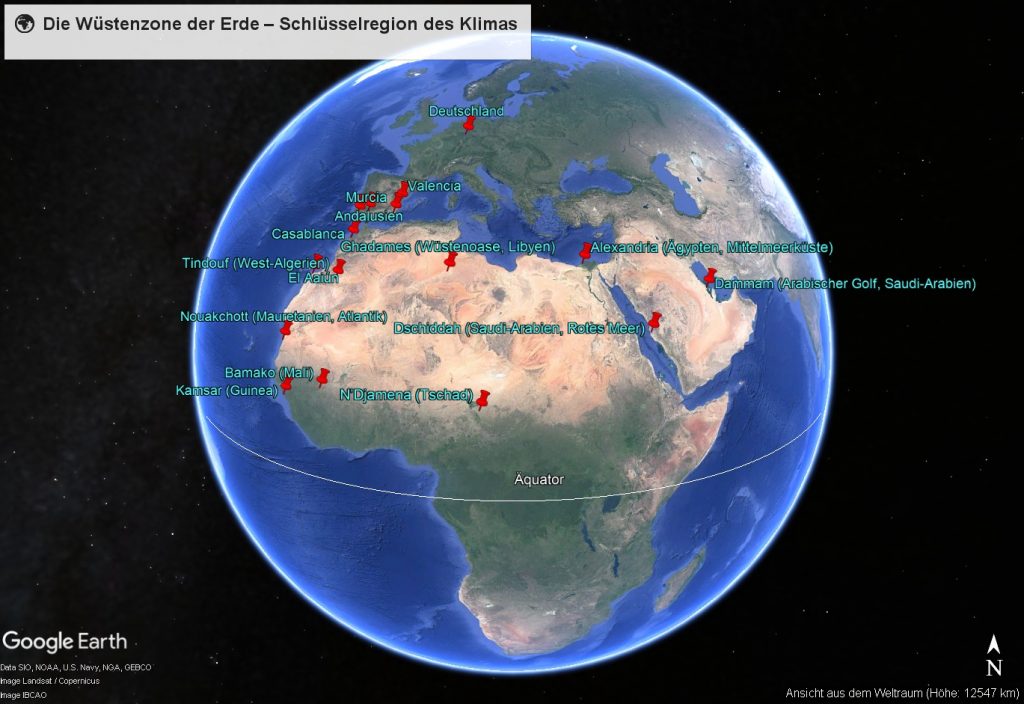
24 🌍 The World’s Desert Belt – A Key Climate Region
The world’s deserts are often seen as marginal — hostile, empty, insignificant. In reality, they are among the central regulators of the global climate. Here, maximum solar radiation, minimal cloud cover, declining albedo, and extreme day-night temperature differences converge.
What happens in the desert does not stay there. Heated air masses influence global circulation patterns, pressure systems, and precipitation far beyond regional boundaries. At the same time, deserts hold enormous potential: solar energy, heat storage, night cooling, seawater evaporation, hydrogen, electric steel, aluminum, and new forms of closed-loop systems.
If we view deserts only as problems, we lose time. If we recognize them as key regions, solutions emerge. OASE concepts, reflective materials, vegetation islands, water management, and intelligently integrated industry can dampen heat, stabilize albedo, and create value — without overburdening natural systems.
The calendar demonstrates that climate protection is not achieved through renunciation alone but through intelligent design. The desert belt is not the end of possibility — it is its beginning.
The message:
Anyone who wants to understand the climate must take the deserts seriously.
| Element | Representation / Notes |
|---|---|
| Main keyword | 🌍 Subtropical Desert Belt – Climate Hotspot |
| Short description | Viewed from an equator-centered perspective, the largest deserts form a broad zone of extreme solar load — decisive for global energy balance, albedo, water cycles, and airflows. |
| Technology & processes | – Harness extreme solar radiation for PV, solar thermal, and electrolysis – Establish OASE systems as starting points for greening – Combine vegetation, water cycles, cooling, and radiative night loss |
| Regional characteristics | Sahara, Sahel, Arabian Peninsula, Australia: highest solar load, low cloud cover, high evaporation, large diurnal temperature swings. |
| Role in the overall system | – Not peripheral but a regulator of the global climate – Greening has planetary effects (albedo, vapor, airflow) – Without active design, deserts amplify warming; with it, they can become climate buffers |
| Explanatory keywords / context | Albedo, solar load, desert belt, OASE, greening, water cycle, sub-cloud dynamics, climate resilience, planetary responsibility |
🌍 Earth’s Desert Zone – A Key Climate Region
| Revision: 1 | Created/Modified: | Tested: | Approved: | Valid from: |
| Date: | 6.02.2026 | 6.02.2026 | 6.02.2026 | 6.02.2026 |
| Signature: | Agent/ChatGPT | supervisory board | executive committee | agent |