
OASE – Reflective Energy Oasis
1. Purpose
The OASE is designed to demonstrate how modular container solutions can combine energy self-sufficiency, water recovery, food production, and social spaces—while giving special consideration to albedo through reflective photovoltaics.
2. Scope
Deployment in extreme environments such as deserts, arid regions, or test sites for future space scenarios. Suitable for both research institutions and practical demonstration facilities.
3. Terms
- OASE: Modular container system for energy, water, and social infrastructure.
- Albedo: The reflectivity of a surface, crucial for climate impact.
- Reflective PV: Photovoltaic modules that reflect light back toward the sun.
- Energy self-sufficiency: Complete self-supply of electricity, water, and resources.
4. Responsibilities
- Development: OASE project team
- Implementation: Partners from research, energy, and construction sectors
- Operation: Local facilities or testing organizations (e.g., desert, Mars simulation)
5. Description
The OASE consists of container modules that can be flexibly combined into a self-sufficient unit. A key feature is PV modules arranged at a 90° angle.
At the equator, they reflect sunlight almost exactly back toward the sun—regardless of the angle of neighboring modules.
This ensures:
- Avoidance of local heating due to diffuse scattering,
- Preservation of albedo, and
- Contribution to climate stability.
The OASE serves as a test field and symbol of a new mindset: technology that not only delivers benefits but actively integrates climate protection.
6. Related Documents
- Fundamentals of photovoltaics and albedo
- Studies on the climate effects of reflective surfaces
- Container module design concepts
7. Documentation
- Drawings (top view, base structures)
- Photos/renderings of container combinations
- Calculations of energy yield and reflection
8. Control
All changes to the concept, modules, and documentation are coordinated and version-controlled centrally within the OASE project team.
9. Appendices
- Current visualizations (top view with 8×12 m containers)
- Tables of energy and water yields
- Expansion modules (e.g., algae reactor, CO₂ filter, aquaponics)
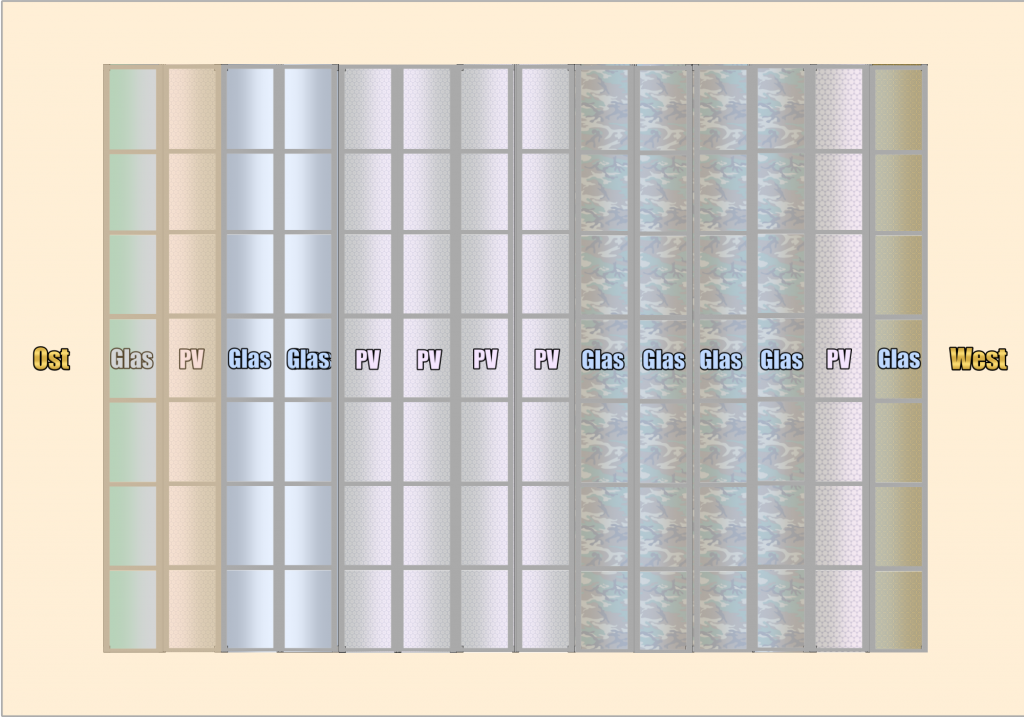
Top view with seven 2.44 m × 12.19 m containers achieving acceptable albedo!
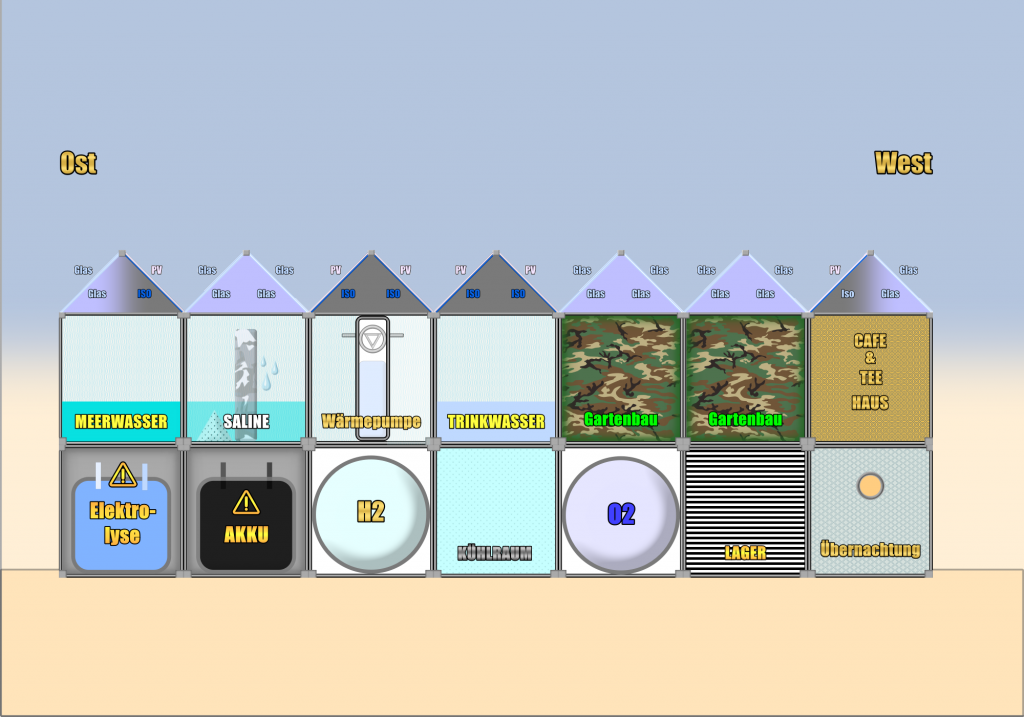
Side view with various stacked containers and roof elements.
Previous Concept:
OASE – A Sustainable Concept for Climate Protection and Resource Management
The “OASE” is a visionary idea that combines sustainable architecture, energy generation, and water management. It is based on modular structures made from container frames that can be deployed flexibly worldwide.
Concept Overview
- Modular construction with container frames
- Use of standardized or customized container frames for rapid assembly.
- Flexible expandability through intermediate modules connecting containers, creating a kind of modern framework.
- Sustainable materials such as stainless steel or alternative constructions using wood or tube frames.
- Efficient use of solar energy via sawtooth roofs
- Sawtooth roof designs with targeted use of photovoltaics, glass surfaces, and mirrors.
- Optimized tilt angles for Europe (145°/35° and 125°/55°) for reflection, absorption, or transmission of solar energy.
- Integration of solar thermal systems for hot water and heating.
- Water and climate management
- Use of seawater desalination through evaporation and condensation.
- Salt recovery as a byproduct for industrial or culinary use.
- Water trenches and indoor planting to create a natural microclimate.
- Application areas and future perspectives
- Agricultural use as a greenhouse or aquaponics system.
- Residential modules for sustainable living in modular structures.
- Combination with storage halls for industrial and logistics applications.
- Global applicability due to modular design and simple transport options.
Why “OASE”?
- Sustainability: Reduced material usage through modular construction and recycling options.
- Energy efficiency: Optimal use of renewable energy for energy generation and climate regulation.
- Flexibility: Adaptable modules for different climate zones and requirements.
- Future-readiness: Scalable concept for worldwide application in urban and rural areas.
With “OASE,” we create an innovative solution for sustainable construction, climate protection, and resource conservation. This concept provides a blueprint for the future and can serve as a global model for sustainable infrastructure.
Early Concept Sketches:

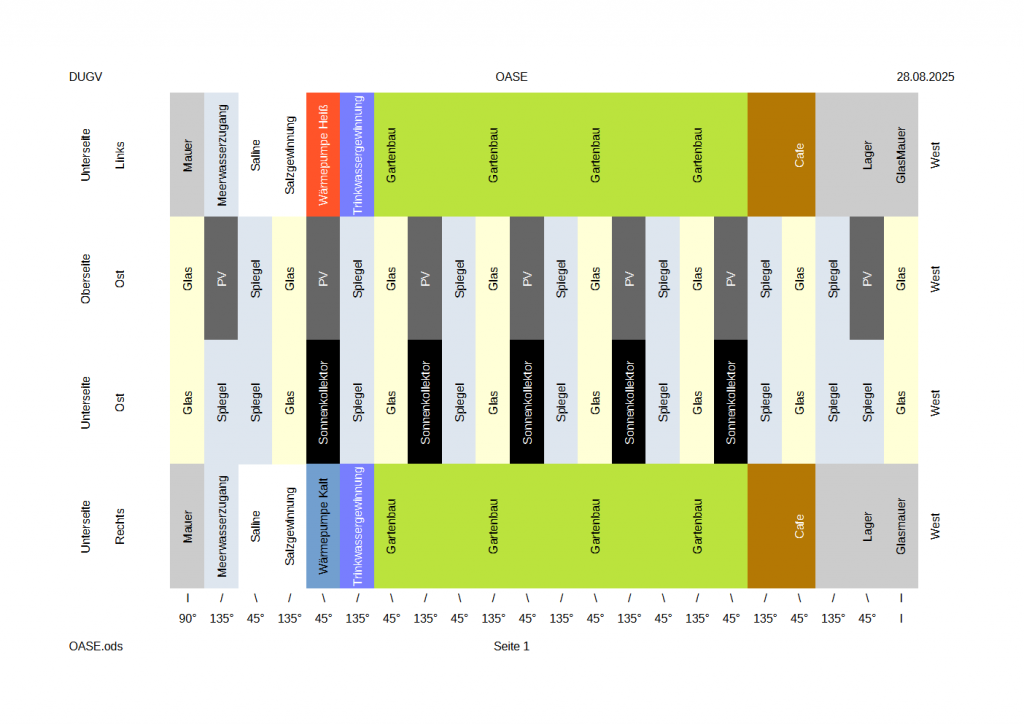
Older development table with details for Europe
Potential supplier:
Globaltainer – Storage & Container Hall Solutions
Continuously adapted and expanded!
| Revision: 1 | Created/Modified: | Tested: | Approved: | Valid from: |
| Date: | 1.02.2026 | 1.02.2026 | 1.02.2026 | 1.02.2026 |
| Signature: | Agent/ChatGPT | supervisory board | executive committee | agent |